


- Home/
- Category/
- Airtac Pneumatic/
- Crossed Roller Way Linear Guide Airtac
/ LRM Series Miniature Linear Guide – High-Precision Compact Linear Rail System


LRM Series Miniature Linear Guide – High-Precision Compact Linear Rail System
The LRM Series Miniature Linear Guide is a compact precision linear motion system designed for smooth travel, low friction and accurate positioning in limited installation spaces. It features high-rigidity stainless-steel rails, precision Japanese steel balls, a ball-retainer system, double-lip seals for improved lubrication retention and protective covers against dust. Available in 5, 7, 9, 12 and 15 mm rail widths, the LRM Series offers standard or long blocks, H/P accuracy grades, multiple preload options and top- or bottom-mount configurations for electronics equipment, precision instruments, compact robots and industrial automation systems.
- LRM
- LRM5
- LRM7
- LRM9
- LRM12
- LRM15
- LRM5N
- LRM5L
- LRM7N
- LRM7L
- LRM9N
- LRM9L
- LRM12N
- LRM12L
- LRM15N
- LRM15L
- LRM5N1
- LRM5N2
- LRM5L1
- LRM5L2
- LRM7N1
- LRM7N2
- LRM7L1
- LRM7L2
- LRM9N1
- LRM9N2
- LRM9L1
- LRM9L2
- LRM12N1
- LRM12N2
- LRM12L1
- LRM12L2
- LRM15N1
- LRM15N2
- LRM15L1
- LRM15L2
- LRM7N1X40S5AHT
- LRM7N1X705T705AHT
- miniature linear guide
- miniature linear rail
- precision linear guide
- compact linear bearing
- LRM linear guide
Design file download links:
PDF fileRAR fileOther fileDescription
Specification:
LRM Series Miniature Linear Guide – High-Precision Compact Linear Rail
The LRM Series Miniature Linear Guide is a compact linear motion guide developed for precision mechanisms with limited installation space. The system consists of a stainless-steel rail, linear block, recirculating steel balls, ball retainers, double-lip seals and protective end covers.
Its compact dimensions, low rolling friction and multiple configuration options make the LRM Series suitable for electronics equipment, measuring instruments, compact robots and precision automation systems.
Product Concept
The LRM Series uses recirculating steel balls between the block and guide rail to produce smooth linear motion. As the block travels along the rail, the balls roll through precision-ground raceways and recirculate through the block’s return path.
Compared with conventional sliding mechanisms, this design provides:
- Lower friction.
- Smooth motion at low and high speeds.
- Good positioning repeatability.
- Compact installation dimensions.
- Stable guidance for precision equipment.
- Reduced drive force requirements.
LRM Series Construction
According to the supplied product images, the LRM Miniature Linear Guide consists of:
- High-rigidity stainless-steel guide rail.
- Precision linear guide block.
- Recirculating steel balls.
- Integrated ball-retainer system.
- Double-lip sealing structure.
- Protective covers at both ends of the block.
- Ball return plates and internal recirculation components.
Stainless-Steel Rail
The guide rail is manufactured from high-rigidity stainless steel, providing good mechanical strength and corrosion resistance for precision machinery.
Rails of the same size are interchangeable with compatible blocks, making installation, replacement and maintenance more convenient.
Ball-Retainer System
The integrated ball retainer prevents the balls from falling out when the block is removed from the rail.
This design provides:
- Easier block-to-rail installation.
- Reduced risk of losing steel balls.
- Faster maintenance and replacement.
- Improved convenience during machine assembly.
- Reduced possibility of incorrect ball installation.
Precision Steel Balls
According to the product introduction, the LRM Series uses Japanese-made steel balls manufactured to ISO 3290 G10 accuracy grade.
The steel balls provide:
- High roundness accuracy.
- Excellent wear resistance.
- Stable rolling contact.
- Smooth block movement.
- Reduced vibration and rolling resistance.
- Long-term motion accuracy.
Double-Lip Seal Design
The block features a double-lip sealing design that improves lubricant retention and dust protection.
This structure helps:
- Retain grease inside the block.
- Reduce the entry of fine dust.
- Protect the ball raceways from contamination.
- Reduce premature wear.
- Extend lubrication and maintenance intervals.
Protective End Covers
Protective covers are installed at both ends of the block to prevent larger dust particles and contaminants from entering the internal ball circulation system.
They are useful in:
- Electronics production equipment.
- Small machining systems.
- Automated assembly lines.
- Machines installed near cutting or handling areas.
- Environments containing dust or small debris.
Available Rail Widths
The LRM Series is available in five rail-width sizes:
- LRM5: 5 mm rail width.
- LRM7: 7 mm rail width.
- LRM9: 9 mm rail width.
- LRM12: 12 mm rail width.
- LRM15: 15 mm rail width.
Smaller sizes such as LRM5 and LRM7 are suitable for ultra-compact mechanisms, while LRM12 and LRM15 provide greater rigidity for larger precision assemblies.
Block Types
Two block-length options are available:
- N – Standard block.
- L – Long block.
The standard block offers compact installation dimensions. The long block provides a larger contact area and improved moment stability for positioning tables and precision mechanisms.
Number of Blocks
The ordering code supports:
- 1: one block on one rail.
- 2: two blocks on one rail.
Using two blocks increases system stability and improves resistance to pitching, rolling and yawing moments.
Surface Treatment Options
The LRM Series offers the following rail and block surface treatments:
- Blank: no additional coating, natural metal finish.
- BB: black chrome coating applied to both the rail and block.
The black chrome option provides additional surface protection for specific operating conditions. According to the catalog note, LRM5 is not available with black chrome plating.
Preload Options
Three preload conditions are available:
- A – Standard clearance.
- B – Light preload.
- C – Medium preload.
Preload selection affects rigidity, running resistance and internal clearance. Higher preload generally improves rigidity and reduces play, but also increases motion resistance.
Accuracy Grades
The LRM Series is available in:
- H – High accuracy.
- P – Precision accuracy.
The H grade is suitable for most precision automation applications. The P grade is intended for mechanisms with stricter positioning and repeatability requirements.
Rail Mounting Types
Two rail mounting methods are available:
- Blank – Top mount.
- T – Bottom mount.
The bottom-mount configuration allows the rail to be fastened from underneath, leaving the upper surface cleaner and supporting special machine layouts.
Ordering Code Example
Example:
LRM7N1X40S5AHT
Code definition:
- LRM: miniature linear guide series.
- 7: 7 mm rail width.
- N: standard block.
- 1: one block per rail.
- X40: 40 mm rail length.
- S5: 5 mm distance from the rail end to the center of the first mounting hole.
- A: standard-clearance preload condition.
- H: high-accuracy grade.
- T: bottom-mount rail type.
When BB appears after the model code, both the rail and block have black chrome surface treatment.
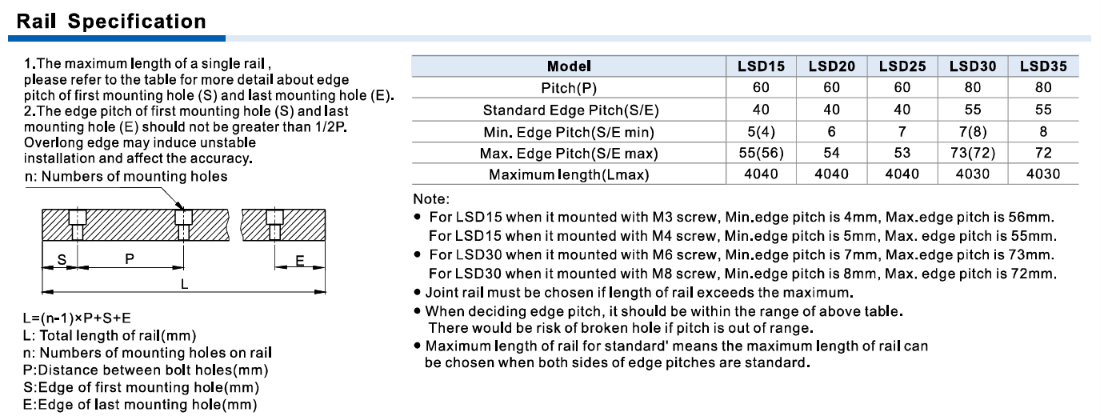
Rail Mounting-Hole Pitch
The standard mounting-hole pitch varies by model:
- LRM5: P = 15 mm.
- LRM7: P = 15 mm.
- LRM9: P = 20 mm.
- LRM12: P = 25 mm.
- LRM15: P = 40 mm.
The total rail length is calculated using:
L = (n − 1) × P + S + E
Where:
- L: total rail length.
- n: number of mounting holes.
- P: mounting-hole pitch.
- S: distance from the first rail end to the first mounting-hole center.
- E: distance from the final mounting-hole center to the opposite rail end.
Standard Edge Pitch
Standard S and E dimensions:
- LRM5: 7.5 mm.
- LRM7: 10 mm.
- LRM9: 12.5 mm.
- LRM12: 15 mm.
- LRM15: 15 mm.
Permitted edge-pitch ranges:
- LRM5: 3–10 mm.
- LRM7: 3–10 mm.
- LRM9: 4–15 mm.
- LRM12: 4–20 mm.
- LRM15: 4–35 mm.
The first and last mounting-hole positions should remain within the recommended range. Excessive rail overhang may cause unstable installation and reduce positioning accuracy.
Maximum Individual Rail Length
The maximum length of one individual rail is:
- LRM5: 495 mm.
- LRM7: 995 mm.
- LRM9: 1005 mm.
- LRM12: 1005 mm.
- LRM15: 990 mm.
A butt-jointed rail configuration can be selected when the required total rail length exceeds the maximum single-rail length.
Butt-Jointed Rail Option
The LRM Series supports butt-jointed rails for longer travel and extended installation lengths.
The T mark in the ordering code identifies the rail joint location. The standard joint-end margin is approximately half of the mounting-hole pitch.
Important considerations include:
- The standard joint configuration uses two rails.
- Assemblies with more than two rails require customization.
- First and last mounting-hole positions must remain within the specified range.
- Custom machining is required when mounting-hole positions fall outside the standard table.
- Butt-jointed LRM5 rails are not available with black chrome plating.
Main Features
- Compact design for limited installation space.
- Precision steel balls for smooth, low-friction motion.
- High-rigidity stainless-steel guide rail.
- Ball retainer prevents balls from falling during disassembly.
- Double-lip seals improve lubricant retention and dust resistance.
- Protective covers help block larger contaminants.
- Standard and long block options.
- One- or two-block rail configurations.
- Top- and bottom-mount rail options.
- H and P accuracy grades.
- A, B and C preload options.
- Butt-jointed rails available for extended lengths.
Product Advantages
- High positioning accuracy for precision motion systems.
- Low friction reduces required drive force.
- Compact dimensions save machine installation space.
- Good structural rigidity relative to product size.
- Smooth motion across a wide speed range.
- Flexible rail lengths and block configurations.
- Easier installation and maintenance with the ball-retainer design.
- Multiple preload options for controlling clearance and rigidity.
- Suitable for both short-travel and long butt-jointed guide systems.
Applications
The LRM Series Miniature Linear Guide is suitable for:
- Electronics assembly machines.
- Semiconductor manufacturing equipment.
- PCB inspection systems.
- Optical measuring instruments.
- Industrial cameras and machine-vision systems.
- Compact desktop robots.
- Pick-and-place mechanisms.
- 3D printers and prototyping equipment.
- Medical and laboratory devices.
- Precision positioning tables.
- Laser engraving and marking machines.
- Small-component packaging equipment.
- Automatic feeding mechanisms.
- Compact industrial automation systems.
Selection Guidelines
When selecting an LRM Miniature Linear Guide, consider:
- Required rail width.
- Applied load and moment.
- Standard or long block.
- Number of blocks per rail.
- Required rail length.
- Mounting-hole pitch and edge-hole positions.
- A, B or C preload condition.
- H or P accuracy grade.
- Top- or bottom-mount configuration.
- Single or butt-jointed rail requirement.
- Dust, humidity and operating environment.
Load capacity, service life and exact block dimensions should be confirmed using the technical specification table for the selected model before ordering.


